
guide · CONTENT-010
How Much Does It Cost to Build an MVP in 2026? (Real Numbers)
MVP cost depends primarily on scope, product complexity, integrations, platforms, design depth, and delivery model. A useful estimate must state its assumptions rather than promise one universal price.

What Is an MVP, Really?
An MVP — Minimum Viable Product — is the smallest working version of your product that solves one core problem for one specific user. Not a prototype. Not a mockup. A real, deployed product someone can actually use today.
The critical distinction: an MVP has 3–4 features. A full product has every feature you can imagine. That gap is the difference between spending $5,000 and spending $50,000.
Most founders build a full product when they only need an MVP. They pay for features nobody asked for, before a single user has validated the idea.
The Real Cost Breakdown in 2026
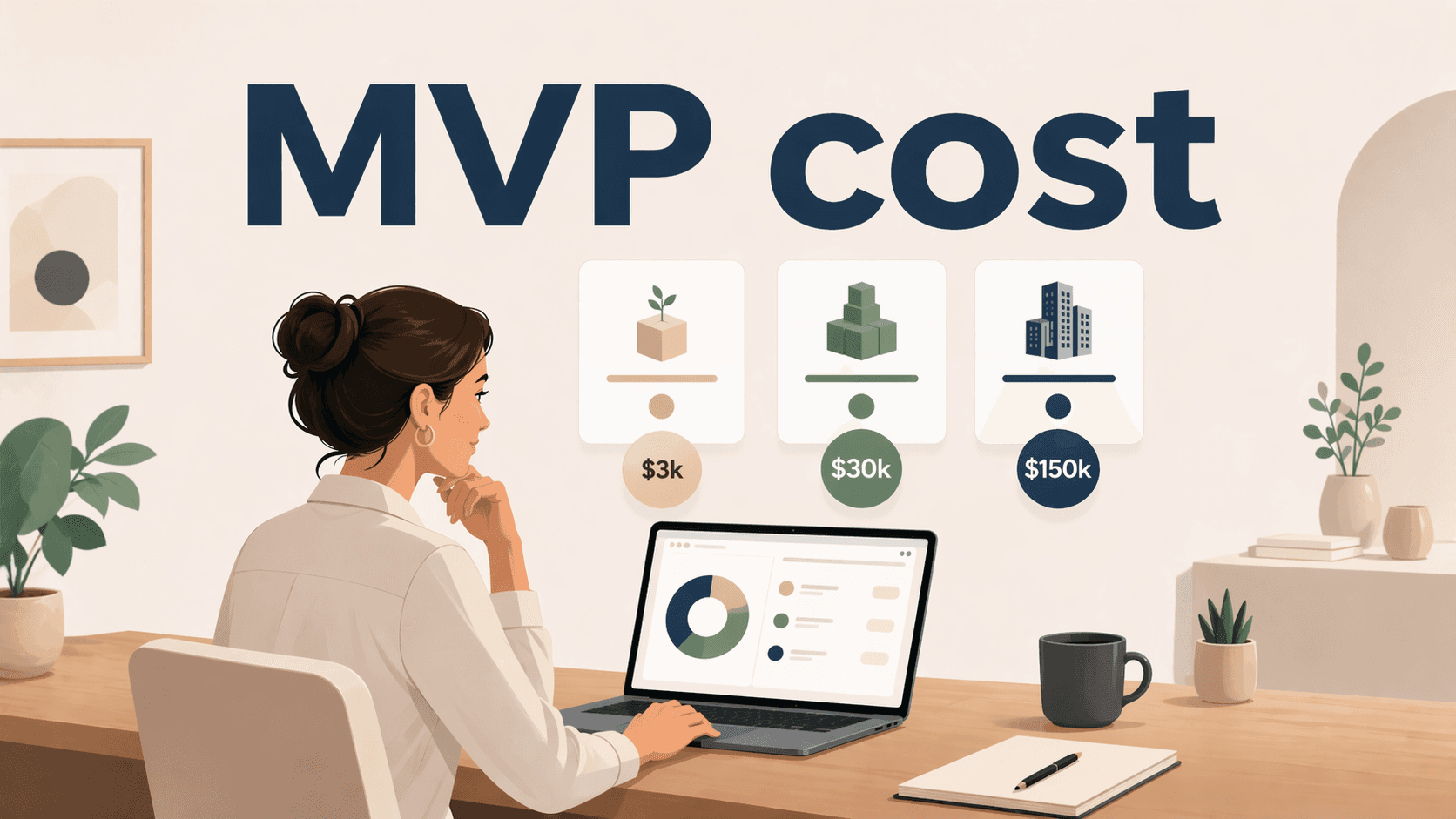
Four main paths to an MVP — each with very different costs, timelines, and tradeoffs:
Freelancer (Upwork / Fiverr) — $5k–$30k
Cheapest on paper, most expensive in reality. Freelancers charge $25–$150/hour. A basic MVP takes 200–400 hours minimum.
The real cost is not the invoice — it is the time. Most freelancers juggle 3–5 clients. Your MVP takes 4–6 months instead of 4–6 weeks. That is months your competitors are ahead of you.
Traditional Agency — $30k–$150k
You pay for a full team: project manager, designer, frontend dev, backend dev, QA tester — whether you need all of them or not. The discovery phase alone costs $5k–$15k before a line of code is written.
This makes sense for a funded startup building something genuinely complex. It does not make sense for a first-time founder validating an idea.
No-Code Tools (Bubble, Webflow, Glide) — $500–$3k
The fastest way to get something working. Bubble handles complex web apps. Webflow is great for landing pages. Glide turns a Google Sheet into a mobile app.
The ceiling comes fast. The moment you need custom logic, real API integrations, or performance at scale — you are rebuilding from scratch. Many founders spend $500 on no-code, then $30,000 rebuilding it six months later.
MVP Specialist Team — $3k–$8k
A category that barely existed five years ago. Small specialist teams — 2 to 3 people — who work exclusively on MVPs. They have templates, a repeatable process, and they move fast because they have solved these problems dozens of times.
The tradeoff: they are opinionated. They will tell you what to cut. That is a feature, not a bug — scope creep is what turns a $6k project into a $40k project.
At Pexa Studio, this is exactly what we do. Fixed price: $3k–$6k. Live in 21 days. 3–4 core features, authentication, a landing page, and production deployment. No hourly billing. No surprises.

What Actually Drives MVP Cost Up
Every founder thinks their idea is simple. Here is what makes it expensive:
User Authentication
Every app needs login, signup, password reset, and session management. Building from scratch: 20–30 hours. Using Clerk or Supabase Auth: 4–6 hours. Most freelancers build from scratch — they are billing hourly.
Payment Processing
Stripe sounds simple. Subscriptions, webhooks, failed payment recovery, refunds, and invoice logic are not. Budget 15–25 hours minimum for a production-grade Stripe integration.
Third-Party Integrations
Every external service you connect — email (Resend), AI (OpenAI), SMS (Twilio), maps (Google Maps) — adds authentication, rate-limit handling, error states, and testing. Budget $500–$2,000 per integration.
Mobile vs Web
A responsive web app that works on mobile costs the same as a desktop site. Native iOS and Android apps cost 2–3× more. For an MVP, always start with a responsive web app.
Scope Creep
The single biggest cost driver. You scope 4 features. By week 3 you have 10. Every added feature is added hours. The founders who spend $5k on their MVP cut ruthlessly. The ones who spend $50k kept saying “just one more thing.”
Hidden Costs Founders Always Miss
The development invoice is not the total. Here is what you will also pay once you are live:
- Domain: $10–$20/year
- Hosting (Vercel, Railway, Render): $0–$50/month
- Database (Supabase, Neon): Free up to ~50k rows, then $25–$100/month
- Transactional email (Resend, SendGrid): Free up to 3,000 emails/month
- Analytics (Plausible, Vercel Analytics): $9–$19/month
- SSL certificate: Free with most hosting providers
Total: roughly $50–$150/month to run a live MVP. Trivial compared to build cost. Do not let infrastructure pricing drive your technical decisions.
How to Get an MVP Built for $3k–$6k
Founders who stay under budget do four things differently:
Define the problem, not the product
Instead of “I want a platform where users can do X, Y, and Z” — say “my user has this one problem and I need to solve it the simplest way possible.” That framing kills 60% of features before anyone writes a line of code.
Pick one user type
Building for buyers and sellers simultaneously doubles complexity and cost. Pick your primary user. Build for them alone until you have traction. Add the second user type in version two.
Use modern tools that eliminate whole categories of work
Next.js, Supabase, Clerk, Stripe, and Vercel replace entire engineering sub-teams for common functionality. A developer fluent in these tools builds in 3 weeks what took 3 months in 2019. When evaluating any developer or agency, ask what stack they use. If they are not using modern tooling, they are billing you for work that should not exist.
Work with a specialist, not a generalist
A developer who builds MVPs every month has already solved your problems. They have templates, shortcuts, and judgment from dozens of past builds. That specialist speed is worth more than generalist flexibility when you are racing to validate an idea.
What You Get at Each Price Point
- Under $3k: A no-code prototype or a landing page. Not a real product.
- $3k–$6k: A production-ready MVP — 3–4 features, auth, landing page, deployed. The right range for idea validation.
- $6k–$20k: A more polished MVP with custom design and complex integrations. Justified if you have paying customers or investor interest.
- $20k+: Something genuinely complex — or you are paying for features you do not need yet.

Should You Build It Yourself?
If you can code — yes. Technical founders who build their own MVPs move faster, iterate cheaper, and understand their product at a level that is hard to replicate.
If you are non-technical, the honest answer: learning to code, then a framework, then deployment and databases, then building the actual product takes 6–12 months minimum. A competitor with the same idea who hired a build partner will have launched, talked to users, and shipped version two in that same window.
Your time as a founder is worth more spent talking to customers and closing early users. The build is one piece of the puzzle — do not let it become the whole puzzle.
The Bottom Line
A well-scoped MVP built by someone who has done it before costs $3,000–$8,000. Founders who spend $50,000+ on their first MVP almost always say the same thing in hindsight: they built too much, too early, for a user they had not yet validated.
Ship the smallest thing that proves your idea works. Talk to users. Then spend more money on the next version.
Frequently Asked Questions
How long does it take to build an MVP?+
A well-scoped MVP built by a specialist team takes 3–6 weeks. Freelancers typically take 3–6 months due to context switching. Agencies can take 2–4 months due to process overhead.
What is the cheapest way to build an MVP?+
No-code tools (Bubble, Webflow, Glide) are the cheapest entry point at $500–$3,000. The risk is hitting a ceiling when you need custom logic or scale. A specialist MVP team at $3k–$6k often delivers better long-term value.
Do I need a technical co-founder to build an MVP?+
No. Non-technical founders successfully launch products every day by working with specialist build partners. What you do need is a clear problem definition and the willingness to cut features ruthlessly.
What features should an MVP have?+
Three to four features maximum — the ones that prove your core value proposition and get someone to sign up or pay. Everything else is version two.
How much does it cost to maintain an MVP after launch?+
Infrastructure costs run $50–$150/month for a typical early-stage MVP. Development costs for ongoing updates depend on complexity, but most MVPs need minimal maintenance in the first few months.
Ready to build your MVP?
Stop losing months to development delays. We ship your MVP in 21 days at a fixed price — so you can spend your time where it actually matters: finding customers and growing your idea.
Book a free callBuilt on Next.js · Supabase · Stripe · Vercel — the same stack powering products at scale.