How a Non-Technical Founder Launches a SaaS in 21 Days

Quick answer: A non-technical founder does not need to learn to code, find a technical co-founder, or pay $30k to an agency. They need a build partner who handles every line of code and ships in 21 days. This is a guide to finding that partner — and avoiding the traps that swallow most non-technical founders' first year.
The Real Problem (And Nobody Says It)
You have an idea. You see the gap in the market. You know your customer better than any developer ever will. The only thing standing between you and a launched product is the code — and you cannot write it.
So you start hunting. You find quotes that scare you ($30,000+). You find freelancers who ghost you. You try Bubble or Webflow and hit walls. Months pass. Your idea sits in a Notion doc, slowly losing energy.
The problem is not your lack of technical skill. The problem is that the market for "build my SaaS" is mostly built for funded startups, not for self-funded founders trying to validate an idea on $5,000.
What You Do Not Need
The advice given to non-technical founders is mostly wrong. Here is what you can safely ignore:
You do not need to learn to code
Coding bootcamps for non-technical founders are a multi-month detour. By the time you are comfortable shipping production code, a competitor with the same idea who hired a builder has launched, talked to users, and shipped version two.
You do not need a technical co-founder
Trading 30–50% of your equity for a co-founder who will write code for free sounds like a deal — until you realise that equity is forever and an MVP costs $5,000. A technical co-founder makes sense once you are scaling. Not for an MVP.
You do not need a $30k agency
Agencies are built for funded startups with money to burn on process. They will sell you a 6-week discovery phase, kickoff decks, and a project manager — none of which write a line of code. You are paying for overhead, not output.
You do not need to write technical specs
If you could write a tech spec, you would be a technical founder. The right partner translates your plain-English description into a build plan. If they ask you to write the spec, you are talking to the wrong person.

The Four Paths Founders Take
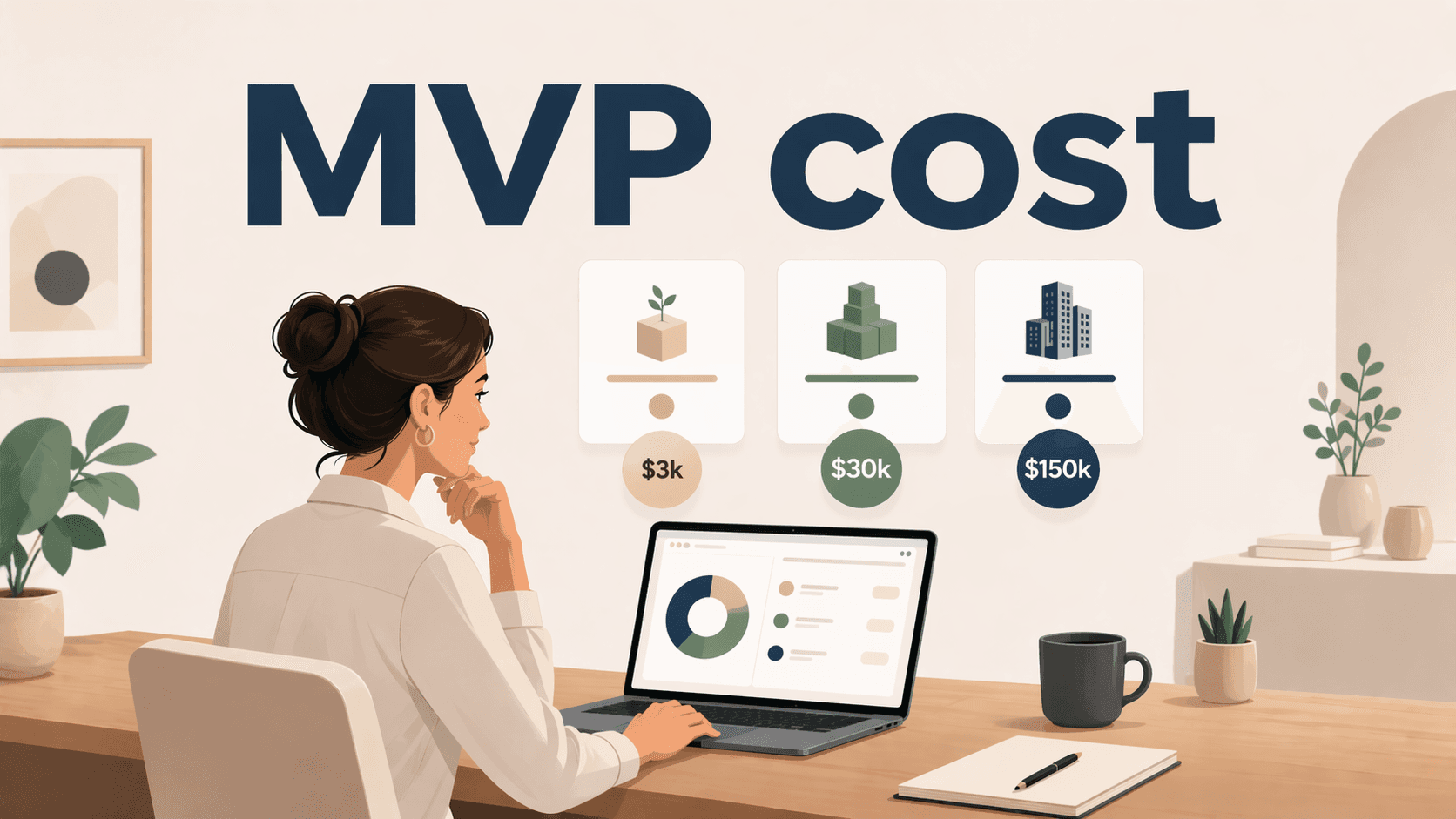
Almost every non-technical founder ends up choosing one of these four paths. Here is what each one really costs:
1. Build it yourself with no-code
$50–$300/month, 2–6 months. Bubble, Webflow, Glide. Cheap to start, slow to learn, expensive to maintain at scale. Most founders who go this route spend 4 months learning Bubble and 0 months talking to customers.
2. Hire a freelancer on Upwork or Fiverr
$5,000–$15,000, 6–12 weeks (often longer). Variable quality. Communication overhead. The freelancer juggles 5 other projects. Many MVPs die in this stage — not from bad code, but from never being finished.
3. Hire a traditional development agency
$20,000–$50,000+, 3–6 months. Process-heavy. Account managers and project managers. Discovery phases that produce decks instead of code. Justified for funded startups, almost never for first-time founders validating an idea.
4. Hire an MVP specialist team
$3,000–$6,000, 21 days. Two or three people who only build MVPs. They have templates, opinions, and a tight process. They cut your scope ruthlessly because they have seen feature creep kill 50 projects before yours.
Path 4 is what we do at Pexa Studio. The other three paths are valid in the right context — they are usually not your context.
How to Find a Trustworthy Builder
The hardest part for a non-technical founder is judging quality without being able to read code. Here is what to look for instead:
They have shipped products before
Ask for live URLs. Real ones, on real domains, with real users. If their portfolio is a Behance page of design mockups, they design — they do not ship.
They give you a fixed price
Hourly billing aligns the builder's interest against yours. The longer it takes, the more they earn. Fixed price aligns interests — they want to ship fast as much as you do.
They tell you what to cut
A good builder pushes back on your scope. They will tell you which features you do not need yet. A builder who agrees to everything you ask for is either inexperienced or planning to bill you for every "scope change" later.
They have an opinion about the stack
"We can build it in anything" is the wrong answer. The right answer is "we use Next.js and Supabase because that is what gets you live fastest and lets any other developer take over later." Specialists are opinionated. That is the whole point.
They commit to a timeline they can keep
21 days, 30 days, 60 days — the number does not matter as much as the commitment. A builder who says "we will see how it goes" has already told you they will not ship on time.
Your Actual Job as a Non-Technical Founder
Once you have a builder, your job changes. You are not project-managing the build. You are doing the work the builder cannot do — and the work that actually moves the business forward.
Talk to your users
Your most valuable asset is direct contact with the people who will use your product. While the build is happening, your job is to line up 20 of them to onboard the day you launch.
Write the copy
You know your customer better than the builder. The headlines, the value props, the FAQ — these come from your conversations, not from the developer's keyboard.
Choose ruthlessly
Every decision the builder asks you to make — feature priorities, UI tradeoffs, copy choices — needs you to choose fast. Indecision is the single biggest project killer for non-technical founders.
Get distribution ready
Build your audience before launch. LinkedIn, Twitter, Reddit, niche communities. The MVP is the easy part. Getting users to it is the hard part.

The 21-Day Path
Here is what 21 days actually looks like, from a non-technical founder's seat:
Days 1–2: Discovery
One call with the builder. You describe the idea, the audience, the goal. By the end you have a written scope: 3–4 features, the timeline, and the price. No technical jargon.
Days 2–3: Send your stuff
Photos, copy, brand colours, anything you have. The builder fills in the gaps. You spend a few hours getting this right, then you are mostly hands-off until day 18.
Days 3–18: Build
You get progress updates and live preview links every few days. Your job is to give feedback fast. Stay ruthless on scope — every "can we also add" delays your launch.
Days 18–21: Launch
The product goes live. You hand over to your audience. The builder hands over the codebase. You start onboarding real users.
Total founder time investment: roughly 5–10 hours over 21 days. The rest of your week is yours — for talking to customers, building distribution, and prepping for launch.
Red Flags to Watch For
- "We will scope it as we go." Translation: we will bill you for every change. Walk away.
- "It will take 4–6 months." Translation: we use a slow stack and slow process. For a first MVP, that is far too long.
- "You need to write a detailed spec first." Translation: we do not know how to translate ideas into product. Walk away.
- "We require a $5k discovery phase." Translation: we will charge you to plan the project before we build it. The plan should be free.
- "We use a custom in-house framework." Translation: only we can maintain it. Lock-in by design. Walk away.
- "We do not show our work mid-build." Translation: surprises at the end. Bad surprises.
The Bottom Line
Being a non-technical founder is not the obstacle. The obstacle is the time you waste on the wrong path — bootcamps, no-code rabbit holes, freelancers who ghost, agencies that overscope.
The right partner removes the obstacle in 21 days for under $6,000. The wrong partner takes 6 months and $30,000 to ship the same thing — or worse, never ships at all.
You do not need to be technical. You need to choose well.
Frequently Asked Questions
Do I need a technical co-founder to build a SaaS?+
No. Many successful SaaS products are built by non-technical founders working with specialist build partners. A technical co-founder makes sense for long-term scaling, not for shipping an MVP.
What if I do not know exactly what I want to build?+
That is the most common starting point. The right build partner will help you define the scope on the discovery call. They have built dozens of products and know which features to include and which to cut.
Can I update the product myself after launch?+
You can change copy, swap images, update pricing, and view your data without writing any code. For deeper changes, you fully own the codebase and any developer can take over.
How much should a non-technical founder spend on an MVP?+
$3,000–$6,000 for a specialist-built MVP is the sweet spot. Less and you are typically getting a no-code prototype that will need rebuilding. More and you are paying for agency overhead you do not need yet.
How do I know if a developer or agency is trustworthy?+
Three signs: they have shipped real products you can visit on the web, they offer fixed pricing instead of hourly billing, and they push back on your scope. Avoid anyone who agrees to everything you ask for.
Stop staring at the Notion doc. Start launching.
We take non-technical founders from idea to live product in 21 days. You bring the idea. We handle every line of code.
Book a free callBuilt on Next.js · Supabase · Stripe · Vercel — the same stack powering products at scale.