SaaS MVP Development: How to Build and Launch in 21 Days

Quick answer: A SaaS MVP is the smallest working version of a software-as-a-service product — landing page, 3–4 features, auth, dashboard, deployment. A specialist team builds one in 21 days. A traditional agency takes 4–6 months for the same result. The difference is process, not skill.
What SaaS MVP Development Actually Means
A SaaS MVP is not a prototype. It is not a Figma file. It is not a "click-through demo." It is a real, deployed product on a real domain that paying customers can sign up for and use today.
The "minimum" part means you cut your idea down to the 3–4 features that prove the concept. The "viable" part means it actually works — sign-ups, data, payments, the lot. Anything between those two is wasted weeks.
Most non-technical founders fail at this stage. They scope a product instead of an MVP. They want every feature on day one. The result is a 6-month build for an idea that takes 6 hours of customer conversations to validate.
The Four Pillars of a SaaS MVP
Every working SaaS MVP, regardless of the niche, has the same four building blocks:
1. A conversion-focused landing page
This is the front door. A clear hero, a clear problem framing, a clear call to action. If a visitor lands here and cannot tell what your product does in five seconds, the rest does not matter.
2. The product itself — three to four features
Three features means three things your user can do that solve their problem. Not 30. Not 12. Three. Every feature you add doubles the surface area of bugs, support, and onboarding work.
3. User authentication and a dashboard
Sign up, log in, password reset, account settings. A clean dashboard where users land after logging in. This used to take 30 hours to build properly. Modern auth tools (Clerk, NextAuth, Supabase Auth) cut that to 4 hours.
4. Production deployment
Custom domain. SSL. Monitoring. Error tracking. Real users on real infrastructure. If you cannot send a sign-up link to a real customer and have it work, you do not have an MVP — you have a demo.

Choosing the Right Stack
The stack you choose determines how fast you ship and how easily someone else can take over later. For a 2026 SaaS MVP, the right answer is boring and proven:
- Frontend: Next.js + React + TypeScript. Industry standard, every developer knows it.
- Styling: Tailwind CSS. Fast, consistent, no design-system bikeshedding.
- Database: Postgres via Supabase or Neon. Real database, no NoSQL detours.
- Auth: Clerk or Supabase Auth. Skip building auth from scratch.
- Payments: Stripe. Always Stripe.
- Hosting: Vercel for the app. Managed cloud for the database.
If your developer or agency wants to use anything more exotic — Rust, custom auth, self-hosted infrastructure — they are optimising for their interests, not yours. You want the stack that any other developer can take over in a weekend if they need to.
Features You Should Cut First
Founders always argue these are essential. They are not. Cut them.
- Multi-language support. Pick one language. Add others when paying customers ask for them.
- Mobile apps. A responsive web app works on every phone. Native apps cost 2–3× more for no early-stage value.
- Admin dashboards. You can manage your first 100 users from the database directly. Build the admin once you actually need it.
- Email marketing flows. Use one transactional email and one welcome email. The 12-step nurture sequence can wait.
- Social login (multiple providers). Email + password is enough. Add Google login when usage data tells you to.
- Dark mode. Pick one theme and ship.
The 21-Day Build Process
Twenty-one days sounds aggressive. It is not, if the process is tight. Here is what each phase looks like:
Days 1–2: Discovery
One call. We define the user, the problem, and the 3–4 features that prove it. We list everything you want and then cut it back. By the end of day 2 you know exactly what you are getting.
Days 2–3: Strategy and scope lock
Locked scope. Locked timeline. Locked price. No mid-project change requests. This is where most agencies fail — they leave scope open and bill you for every iteration.
Days 3–18: Build
Daily progress. Live preview links. You see the product taking shape every day, not at the end. Bugs caught early cost minutes. Bugs caught at the end cost weeks.
Days 18–21: Launch
Production deployment. Smoke tests. Domain transfer. Hand-off documentation. You go live with everything you need to start onboarding paying users.

The Five Mistakes That Kill MVPs
1. Building before talking to users
The most expensive mistake. Founders write 40 features into a Notion doc, build all of them, then discover users only wanted one. Talk to ten people before you write a single line of code.
2. Picking the wrong audience
Building for "everyone" means building for no one. Pick one user, one job-to-be-done. Add the second user type only after you have paying customers in the first.
3. Hiring on price alone
The $25/hour freelancer who takes 4 months costs more than the $5,000 specialist team that ships in 21 days. Time is the actual cost. Always.
4. Letting scope creep in
Every "just one more feature" delays your launch by a week. Lock scope on day 3 and treat additions as version 2 work, not version 1.
5. Skipping production polish
An MVP that crashes on the first paying customer is worse than no MVP. Set up error tracking, analytics, and basic monitoring on day one. Ten minutes of setup saves a week of debugging at scale.
What Happens After Launch
Day 22 is when the real work starts. Your MVP is live. You have a domain, a working product, and one job: get users to use it.
For the first 30 days post-launch, your job is conversations — onboarding, support, asking why people sign up and why they leave. Every conversation tells you what to build next. The MVP gives you the right to have these conversations.
After 30 days, you will have a list of changes that came directly from real users. That list is worth more than every roadmap document you wrote before launching.
The Bottom Line
SaaS MVP development is a process problem, not a coding problem. The teams that ship in 21 days are not faster typists than the teams that take 4 months — they have a tighter process, a tighter scope, and a tighter feedback loop.
For a non-technical founder, the leverage is in finding a partner who runs that process well. The code is commodity. The judgment about what to build, what to cut, and how to launch is not.
Frequently Asked Questions
How is a SaaS MVP different from a regular MVP?+
A SaaS MVP includes recurring user accounts, authentication, and typically subscription billing — all the moving parts of a software-as-a-service business. A regular MVP might just be a one-time-use tool or a marketplace listing. The infrastructure is heavier in a SaaS MVP.
Can a SaaS MVP really be built in 21 days?+
Yes, when scope is locked and the team has done it before. The 21-day timeline is not aggressive coding — it is removing the discovery phases, change-request cycles, and process overhead that make traditional agencies take 4–6 months for the same output.
What stack should a SaaS MVP use in 2026?+
Next.js, TypeScript, Tailwind, Supabase or Postgres, Clerk or Supabase Auth for authentication, Stripe for payments, and Vercel for hosting. This is the boring, proven stack any developer can take over.
Do I need investors before building a SaaS MVP?+
No. The whole point of an MVP is to validate without raising money. Most founders should self-fund a $3k–$6k MVP, get to 10 paying users, and then decide whether to raise.
What is the typical cost of SaaS MVP development?+
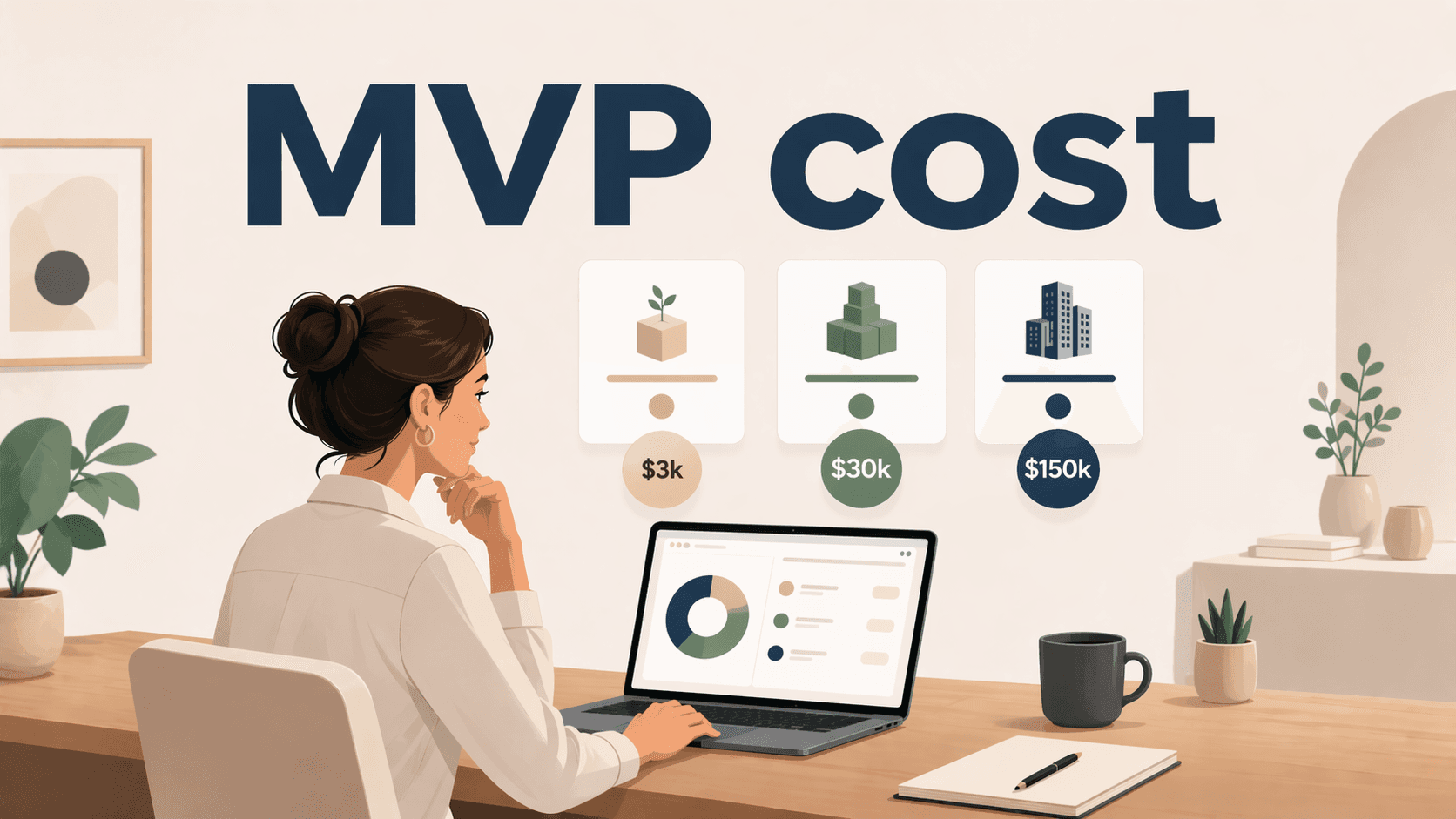
A specialist team charges $3,000–$6,000 fixed price. A traditional agency charges $20,000–$50,000+. A freelancer charges $5,000–$15,000 but typically takes 3× longer.
Ready to build your SaaS MVP?
We take non-technical founders from idea to live, working SaaS in 21 days. Fixed price. No surprises.
Book a free callBuilt on Next.js · Supabase · Stripe · Vercel — the same stack powering products at scale.